Some places end where highways disappear, mobile signals fade, and the noise of everyday life feels impossibly distant. Reaching them may involve small aircraft, boats, mountain roads or long journeys through wilderness. For travellers seeking something beyond conventional tourism, a Luxury travel and tour operator in India can turn these remote corners of the world into carefully designed journeys where isolation doesn’t mean sacrificing comfort. Here, the greatest luxury is often not what surrounds you, but what it lacks: crowds, traffic, schedules, and distractions.
Remote travel has always carried a sense of adventure.
But a new generation of travellers is discovering that isolation and luxury can exist together.
You can wake in a sophisticated lodge surrounded by Patagonian mountains, cross an African desert before returning to an elegant camp, watch Arctic landscapes from a secluded retreat or spend several days on an island where the ocean seems to stretch forever.
These journeys redefine what it means to escape.
Destinations Where the Road Ends
Why Remoteness Has Become a Modern Luxury
For much of travel history, luxury meant convenience.
The best hotel was centrally located. The fastest transportation was preferred. The most desirable destinations were places with restaurants, shopping and entertainment nearby.
Those things still matter, but the definition of luxury has expanded.
For many travellers, genuine space has become increasingly valuable.
Modern life is filled with connectivity. Phones are always nearby. Messages arrive constantly. Cities rarely become completely quiet.
Remote destinations create a temporary break from that environment.
A wilderness lodge may have no neighbouring buildings. A desert camp might sit beneath a horizon uninterrupted by roads. An isolated island can make the rest of the world feel very far away.
That feeling is difficult to manufacture.
It comes from geography itself.
The Difference Between Remote Travel and Difficult Travel
Remote does not necessarily have to mean uncomfortable.
That distinction is important.
Adventure travel traditionally involved accepting a certain level of inconvenience to reach extraordinary places.
Modern luxury travel has changed the equation.
Travellers can now access remote environments while enjoying thoughtful accommodation, knowledgeable guides, carefully planned transportation and high-quality dining.
The journey may still require effort.
A small aircraft might be necessary. A boat transfer may take several hours. Mountain roads may be unavoidable.
But the logistics can be designed so that the complexity remains largely invisible to the traveller.
That is where thoughtful planning becomes part of the luxury.
Patagonia: At the Edge of South America
Few places communicate remoteness as powerfully as Patagonia.
Stretching across southern Argentina and Chile, the region is characterised by mountains, glaciers, enormous grasslands, forests and powerful weather systems.
Distances can be significant. Settlements become smaller. Roads pass through landscapes that seem almost empty.
For travellers arriving from major cities, the contrast is immediate.
Torres del Paine
Chile’s Torres del Paine region is one of Patagonia’s most recognisable landscapes.
Granite peaks rise dramatically above lakes and open valleys.
Hiking routes provide opportunities to experience the terrain at different levels of difficulty.
But travellers do not necessarily need to undertake demanding multi-day expeditions.
A luxury journey can combine guided walks with scenic drives, wildlife observation and comfortable lodge stays.
The important element is access to the landscape.
A well-positioned property lets travellers wake to mountain views and start exploring without unnecessary travel.
Argentine Patagonia
Across the border, Argentine Patagonia offers another interpretation of the region.
Glaciers, mountain towns and vast open landscapes create opportunities for scenic exploration.
The Perito Moreno Glacier is one of the region’s best-known natural landmarks, while areas farther south provide a sense of approaching the end of the continent.
Patagonia’s appeal lies partly in its scale.
The landscapes do not simply surround travellers. They dominate the experience.
Greenland: Silence on an Extraordinary Scale
Greenland feels unlike almost anywhere else.
Ice covers much of the island. Small settlements sit between mountains and sea. Icebergs drift through coastal waters.
Road connections between communities are limited, meaning transportation often depends on boats or aircraft.
This geography makes Greenland inherently adventurous.
It also creates extraordinary opportunities for travellers seeking solitude.
Exploring the Ice
Ice defines the landscape.
Glaciers and icebergs create constantly changing scenery.
A boat journey through iceberg-filled waters can reveal shapes, textures and colours that appear almost sculptural.
The environment also encourages travellers to slow down.
There is little need to rush.
The landscape itself is the attraction.
Summer and Winter Experiences
Greenland changes dramatically with the seasons.
Summer brings extremely long daylight hours in northern regions, allowing travellers to explore landscapes late into the evening.
Winter brings darkness, snow, and opportunities to see the Northern Lights.
The ideal season therefore depends entirely on the kind of journey the traveller wants.
Namibia: Luxury in the Desert
Namibia offers some of Africa’s most visually distinctive landscapes.
Its enormous deserts, dramatic dunes and sparsely populated regions create an extraordinary sense of space.
The Namib Desert is among the world’s oldest deserts, and its landscapes can feel almost otherworldly.
The Dunes of Sossusvlei
Sossusvlei is famous for towering red dunes and stark desert scenery.
Early morning light can transform the landscape as shadows move across the sand.
Exploring the area with a private guide helps travellers understand the geology and ecology, rather than simply photograph the scenery.
Afterwards, a remote desert lodge can provide a completely different kind of luxury.
The absence of city lights creates spectacular night skies.
You can enjoy dinner beneath the stars.
The silence becomes part of the experience.
The Skeleton Coast
Namibia’s Skeleton Coast takes remoteness even further.
Desert meets the Atlantic Ocean along a coastline historically known for shipwrecks and difficult conditions.
The combination of fog, dunes and ocean creates a landscape unlike conventional beach destinations.
Travelling here is not about swimming beside a resort.
It is about experiencing the raw character of the environment.
Bhutan: Remoteness Through Culture
Not every remote journey needs to involve complete wilderness.
Bhutan offers another form of escape.
The Himalayan kingdom combines mountain landscapes with deeply rooted cultural traditions.
Travelling through Bhutan often involves winding mountain roads, valleys and small settlements.
The slower pace is part of the journey.
Monasteries in the Mountains
Bhutan’s monasteries and religious sites provide some of its most memorable experiences.
The famous Tiger’s Nest monastery sits dramatically against a cliffside near Paro.
Reaching it requires a hike, turning the visit into a journey rather than a simple sightseeing stop.
Elsewhere, quieter monasteries and valleys provide opportunities to understand Bhutanese culture beyond its most photographed landmarks.
A Different Rhythm of Travel
Bhutan encourages travellers to slow down.
Distances that appear short on a map can take longer because of mountain roads.
Rather than treating this as an inconvenience, a thoughtfully designed itinerary uses the journey itself as part of the experience.
Villages, landscapes and cultural encounters become meaningful stops rather than obstacles between attractions.
The Arctic: Travelling into the Far North
The Arctic represents one of the world’s great frontiers.
It is not a single destination but a vast region extending across several countries and territories.
Its landscapes include glaciers, tundra, mountains, sea ice and remote coastal environments.
Travelling here requires respect for the conditions.
Weather can change quickly. Distances are enormous. Wildlife experiences depend on natural behaviour rather than schedules.
This unpredictability is precisely what makes the Arctic compelling.
The Luxury of Expert Guidance
In remote environments, expertise becomes one of the most valuable luxuries.
An experienced guide understands weather, terrain, wildlife and local conditions.
They know when plans need to change.
They can interpret landscapes that might otherwise appear empty.
In the Arctic, this knowledge is not simply convenient.
It is fundamental to the journey’s quality and safety.
Antarctica: Beyond the Ordinary Map
Few destinations feel more remote than Antarctica.
The continent exists beyond conventional cities, highways and permanent tourism infrastructure.
Reaching it usually involves expedition travel by sea or air supported by specialised operators.
The journey itself reinforces the sense of distance.
A Landscape Dominated by Nature
Antarctica offers enormous ice formations, glaciers, mountains and wildlife adapted to extreme conditions.
No historic city centres to explore. No shopping districts. No traditional resort towns.
Nature controls the itinerary.
Weather can determine whether a landing is possible. Wildlife may appear unexpectedly. Sea conditions can change plans.
This creates a travel style where flexibility is essential.
Luxury Expedition Travel
Modern expedition vessels have transformed how travellers can experience polar regions.
Comfortable cabins, sophisticated dining and expert expedition teams can provide a high level of comfort while maintaining the spirit of exploration.
The luxury is not about isolating travellers from Antarctica.
It is about giving them a comfortable base from which to experience it.
The Faroe Islands: Europe’s Wild Atlantic Escape
Between Iceland and Norway lies an archipelago characterised by dramatic cliffs, green mountains and small coastal settlements.
The Faroe Islands feel surprisingly remote despite their location within Europe.
Road tunnels and ferries connect communities, but the landscape remains dominant.
Weather changes quickly. Clouds move across mountains. Ocean views appear around almost every turn.
Exploring Slowly
The Faroe Islands reward travellers who resist the urge to rush.
You can explore small villages on foot.
Hiking trails provide views across cliffs and ocean.
Local food introduces another dimension to the culture.
The destination is particularly attractive to travellers interested in photography, nature and quiet landscapes.
Mongolia: Luxury Beneath an Endless Sky
Mongolia offers a completely different interpretation of remoteness.
Its enormous steppe landscapes, desert regions, and low population density create a sense of space that is difficult to comprehend until you experience it.
Outside major urban areas, roads can disappear into tracks across open terrain.
The horizon seems endless.
The Gobi Desert
The Gobi is one of Mongolia’s most famous landscapes.
It contains deserts, rock formations, and wide-open terrain.
Luxury camps offer comfortable accommodation while staying connected to the surroundings.
Travellers can spend days exploring before returning to a private camp in the evening.
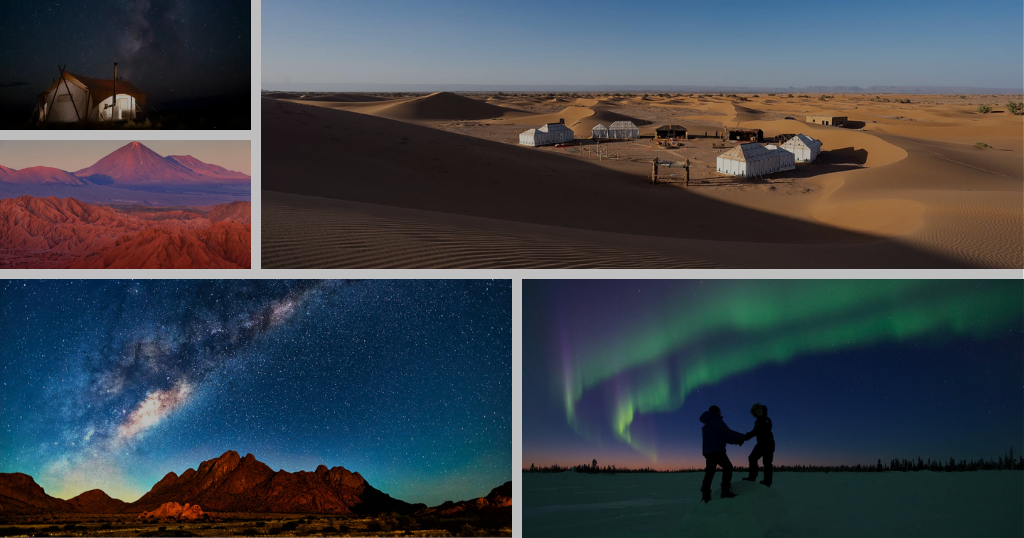
At night, the lack of artificial light reveals extraordinary skies.
Connecting With Nomadic Culture
Mongolia’s cultural experiences can be equally powerful.
Responsible encounters with nomadic communities provide insight into traditions shaped by the landscape.
The experience reminds travellers that remoteness does not mean emptiness.
People have adapted to these environments for generations.
Remote Islands: When the Ocean Creates the Distance
Islands naturally create a sense of separation.
But some island destinations take that feeling much further.
Reaching them may require a combination of international flights, smaller aircraft and boat transfers.
Once travellers arrive, the journey’s complexity becomes part of the reward.
Private Island Experiences
A private island can offer one of the clearest examples of modern luxury.
The appeal is not simply expensive accommodation.
It is space.
Beaches may feel almost empty. Dining can be personalised. Activities can follow the traveller’s schedule.
There is little reason to watch the clock.
Days begin to follow natural rhythms instead.
Marine Exploration
Remote islands also provide opportunities to experience the ocean more deeply.
Snorkelling, diving, sailing, kayaking and wildlife observation can become central parts of the journey.
The underwater environment may be as important as the island itself.
This creates a holiday built around exploration rather than simply relaxation.
Alaska: Wilderness on a Monumental Scale
Alaska combines enormous landscapes with relatively accessible adventure.
Mountains, glaciers, forests and remote coastline create countless opportunities for wilderness travel.
Some locations are accessible primarily by small aircraft or boat.
This means the journey can quickly move beyond conventional road-based tourism.
Remote Lodges
A wilderness lodge can provide a comfortable base for exploring.
Activities might include wildlife observation, fishing, hiking or glacier experiences depending on the location and season.
At the end of the day, travellers can return to warmth, good food and comfortable accommodation.
Again, the contrast between wilderness and comfort is what makes the experience distinctive.
The Scottish Highlands: Remoteness Closer to Home
Remote luxury does not always require travelling to the polar regions.
The Scottish Highlands demonstrate how landscapes can create a powerful sense of isolation even within a relatively accessible destination.
Mountains, lochs, islands, and historic estates offer opportunities for road journeys, hiking, and cultural exploration.
A remote country property can offer fireplaces, exceptional food and peaceful surroundings after a day outdoors.
The Highlands also work particularly well for travellers who enjoy combining nature with history.
Castles, villages and traditional culture add depth to the landscape.
Planning and the Experience of Getting There
Why Remote Accommodation Matters
In conventional city travel, accommodation is often one element among many.
In remote travel, it can become central to the experience.
Location matters enormously.
A lodge overlooking a glacier offers a different experience from one that requires hours of travel to reach the landscape.
A desert camp positioned away from artificial light can transform nighttime.
A wilderness property near hiking routes can reduce unnecessary transfers.
Architecture also matters.
The finest remote properties often respond to their surroundings rather than competing with them.
Large windows frame views. Natural materials connect interiors with the environment. Outdoor spaces encourage guests to spend time observing the landscape.
Food in the Middle of Nowhere
One unexpected pleasure of remote luxury travel is discovering exceptional food in places where it seems almost impossible.
Logistics can be challenging.
Ingredients may need to travel long distances.
Seasonal availability can shape menus.
Yet these constraints can encourage creativity.
Some properties focus heavily on local ingredients, allowing the cuisine to reflect the region.
Seafood may dominate coastal destinations. Local produce can shape mountain menus. Traditional techniques may influence dishes in culturally rich regions.
Dining becomes another way of understanding the destination.
The Role of Technology in Remote Travel
Technology creates an interesting tension in remote luxury.
Travellers may want to disconnect, yet technology can improve safety, communication and logistics.
Some remote properties provide strong connectivity.
Others intentionally limit it.
There is no universally correct approach.
For some travellers, having internet access provides reassurance.
For others, being temporarily unreachable is part of the attraction.
The important thing is knowing what to expect before travelling.
Responsible Travel in Fragile Places
Remote destinations often contain fragile ecosystems and small communities.
That makes responsible travel particularly important.
Visitor numbers can put pressure on environments never designed for mass tourism.
Waste management can be difficult.
Wildlife can be sensitive to disturbance.
Local traditions can also be affected when tourism grows too quickly.
Travellers should therefore consider how accommodation and experiences interact with the destination.
Smaller groups, responsible wildlife practices and support for local communities can reduce negative impacts.
Luxury travel should preserve the qualities that made the destination worth visiting in the first place.
Why Getting There Is Part of the Experience
Remote travel challenges the idea that transportation is simply something to endure.
A small aircraft flying over mountains can provide spectacular views.
A boat approaching an isolated island creates anticipation.
A train moving through wilderness can reveal changing landscapes.
A long road journey can introduce travellers gradually to the environment.
When designed properly, these transitions make the destination feel more rewarding.
Instant arrival can sometimes remove the sense of discovery.
Remote journeys restore it.
Who Is Remote Luxury Travel For
Remote travel is not only for extreme adventurers.
Different destinations can suit very different travellers.
Couples may appreciate privacy and uninterrupted time together.
Photographers can benefit from extraordinary landscapes and changing light.
Families may value educational wildlife and cultural experiences.
Adventure travellers can explore challenging environments.
Wellness travellers may simply want silence and space.
The common factor is curiosity.
Remote destinations reward people who enjoy the journey as much as the destination.
How to Plan a Remote Luxury Journey
Planning matters most when travelling far from major tourism centres.
Connections need to work.
Weather needs to be considered.
Seasonality can completely change an experience.
Travellers should also avoid trying to include too many remote destinations in one itinerary.
Reaching them takes time.
Once there, staying longer usually creates a better experience.
A three-night stay may let travellers settle into the destination’s rhythm, while a rushed overnight visit can make the journey feel dominated by transportation.
Flexibility is equally important.
Weather may change. Wildlife may behave unexpectedly. Flights may operate differently from large commercial routes.
The best remote itineraries include enough flexibility to adapt.
When There Is Nothing to Do, Everything Changes
One of the most interesting aspects of remote travel is what happens when conventional entertainment disappears.
There may be no shopping centre. No busy nightlife. No long list of attractions.
Instead, travellers start noticing simpler things.
The changing light. Weather moving across mountains. Birds flying over water. The sound of waves. A conversation over dinner. A clear night sky.
At first, this can feel unfamiliar.
Then it becomes the point of the journey.
Luxury is no longer measured by how many activities are available.
The quality of the experience measures it.
The Emotional Value of Distance
Physical distance can create psychological distance.
When travellers move far enough away from their normal environment, everyday concerns can begin to feel less immediate.
A vast landscape creates perspective. A quiet island slows the pace of thought. A desert encourages stillness. A mountain reminds travellers of scale.
This emotional effect is hard to quantify, yet it is one reason remote travel can feel so powerful.
People return not only with photographs but with a different relationship to time and space.
Conclusion: Finding Luxury at the End of the Road
The world’s remote places remind us that luxury does not always need to be loud, visible or elaborate. Sometimes it is a Patagonian landscape with no buildings on the horizon. Sometimes it is an iceberg drifting silently through Greenlandic waters, dinner beneath the Namibian stars or waking on an island surrounded by nothing but ocean.
Reaching these places requires more thought than booking an ordinary holiday. Geography, weather, transportation, seasonality and responsible access all matter. Yet that complexity is also what protects their sense of discovery. When every element is planned carefully, the journey can feel effortless without losing its adventurous character.
For travellers who believe the most extraordinary experiences begin where conventional tourism ends, a Luxury travel and tour operator in India can bring together specialist knowledge, thoughtful logistics and carefully selected stays to make the world’s most remote places feel wonderfully within reach.